
Subtotal $0.00

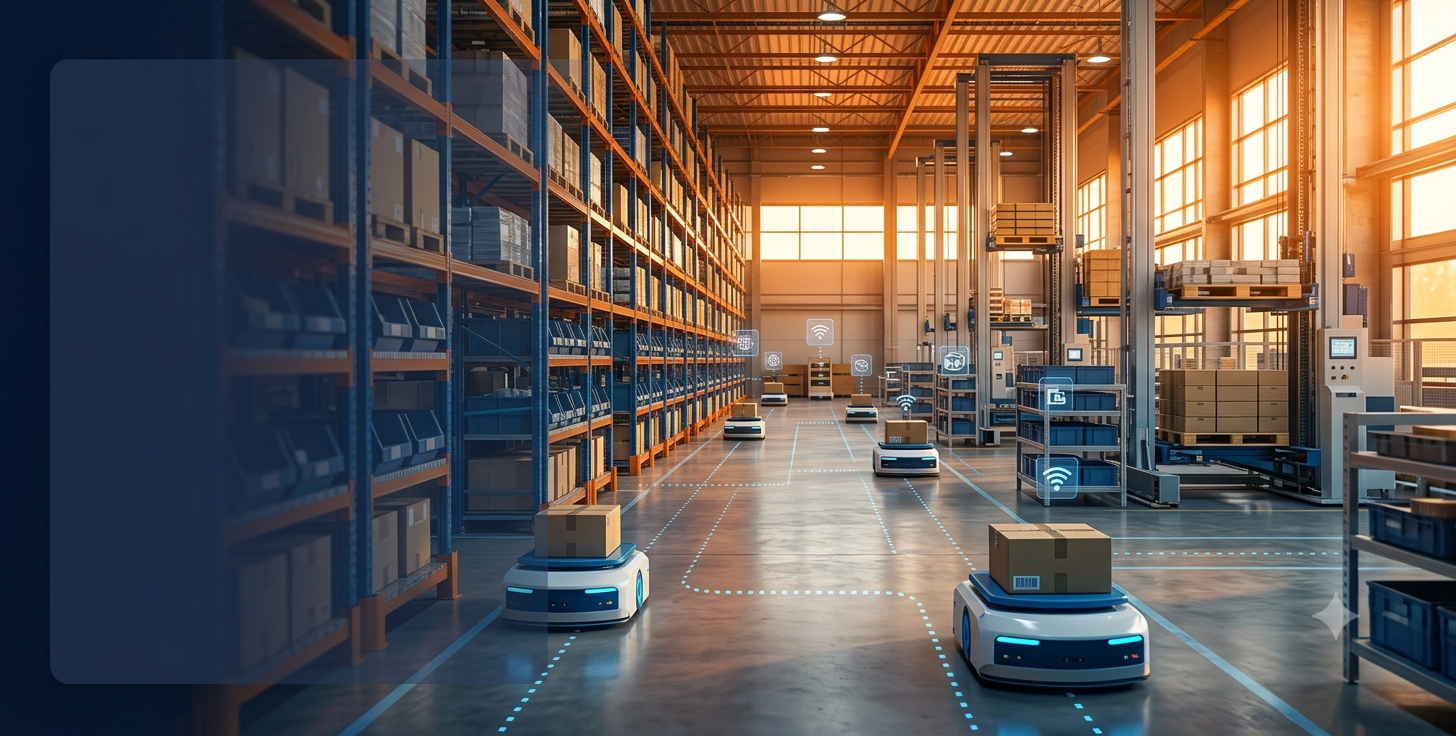
The warehouse has quietly become the most strategically important building in the supply chain. It’s no longer a place where boxes sit between “made” and “sold” — it’s a live, data-driven node that decides how fast a business can move, how cheaply it can operate, and how well it can absorb the next shock. Here’s what’s actually changing in 2026, and why it matters for operators across Southeast Asia and beyond.
1. The market is still growing fast
Global warehousing and storage is on track to approach roughly $869 billion by 2026, and the growth is not evenly spread. Southeast Asia in particular is emerging as one of the fastest-moving regional stories: the SEA warehouse automation market alone is valued at around $0.9 billion in 2026 and is projected to more than double to $1.6–1.9 billion by 2031, growing at roughly 12% a year. Indonesia currently holds the largest country share in the region, while conveyor and sortation systems remain the single biggest product category, reflecting how parcel-heavy and hub-and-spoke the region’s logistics networks are.
Across wider Asia-Pacific, the numbers are even steeper the market is expected to jump from about $14.2 billion in 2025 to $17.4 billion in 2026, on its way to nearly $38.6 billion by 2031. The driver is the same everywhere: e-commerce volume is outrunning the capacity of manual operations to keep up.
2. AI has moved from back-office analytics to the warehouse floor
For years, “AI in warehousing” mostly meant demand forecasting dashboards. That’s changed. AI is now acting as an operational layer that sits above the warehouse management system (WMS), ERP, and sensor network interpreting live data, predicting bottlenecks, and guiding decisions in real time rather than in a weekly report. Slotting optimization, conversational query tools for floor staff, and automated exception-handling are becoming standard rather than experimental.
This shift matters commercially: it means the pitch to prospective customers is no longer “we have a system that tracks inventory” it’s “we have a system that tells you what to do next, continuously.”
3. Robotics adoption is entering the mainstream, not just the pilot stage
By 2026, an estimated 4.28 million commercial warehouse robots will be installed worldwide. What’s notable is the mix: most facilities now run a blend of AGVs (fixed-route automated guided vehicles) and AMRs (autonomous mobile robots that navigate dynamically), alongside robotic picking, palletizing, and sortation arms.
Robotic AS/RS (automated storage and retrieval systems) are increasingly replacing traditional pick modules, cutting travel time and adapting in real time to shifting demand patterns. DHL has reported that autonomous mobile robots have roughly doubled picking productivity in some of its fulfilment operations a data point that’s doing a lot of work in automation business cases right now.
4. Southeast Asia’s e-commerce boom is the real automation driver
This is the trend worth watching most closely for anyone operating in the region. Southeast Asia’s digital economy hit roughly $263 billion in gross merchandise value in 2024, up 15% year-on-year, with e-commerce as the single biggest contributor. Video commerce — live-stream selling — has grown from under 5% to about 20% of SEA e-commerce GMV in just two years, which is reshaping order profiles (smaller, more frequent, more return-prone) in ways warehouses have to design around.
Government-backed logistics parks in Indonesia and Vietnam are shortening payback periods for automated storage systems, while land scarcity and rising wages in Singapore are pushing faster adoption of autonomous mobile robots for vertical storage density. Meanwhile, dark-store and quick-commerce formats in Jakarta and Bangkok are demanding high-speed sortation capacity that manual operations simply can’t deliver during peak windows.
5. Visibility is now table stakes, not a differentiator
Real-time, end-to-end visibility powered by IoT sensors, AI, and cloud platforms has moved from “nice to have” to baseline expectation. What separates leaders from the rest in 2026 isn’t whether they have visibility, but how fast they act on it. Organizations are consolidating fragmented data streams into unified views specifically to cut manual tracking and enable proactive rather than reactive decisions.
6. Continued geopolitical disruption is keeping resilience front and center
The geopolitical volatility of 2025 hasn’t eased tariffs, trade tension, and regional conflicts continue to cloud logistics projections. This is pushing warehousing strategy toward resilience rather than pure efficiency: diversified sourcing, buffer inventory positioning, and flexible automation that can be redeployed across changing demand patterns rather than locked into a single fixed process.
7. Buildings themselves are changing shape
On the construction side, the industry is in an active build cycle, driven by e-commerce growth, supply chain realignment, and reshoring. New industrial construction is increasingly built with 36- to 40-foot clear heights as standard, with some large fulfillment centers going even higher a direct response to rising land costs and shrinking available sites near population centers. Vertical storage density is no longer just an automation strategy; it’s now a building-code-level design decision.
What this means for operators and marketers in the space
For supply chain and logistics platforms like SCMProfit, the throughline across all of these trends is the same: the warehouse is becoming a software and data problem as much as a physical one. Buyers evaluating automation partners are no longer just asking about throughput numbers; they’re asking how a system integrates with existing WMS/ERP stacks, how quickly it adapts to demand swings like quick-commerce spikes, and how resilient it is to disruption.
For Southeast Asia specifically, the story in the second half of 2026 is one of catch-up and acceleration happening simultaneously markets like Indonesia and Vietnam building automation into new logistics parks from day one, while more mature markets like Singapore push toward density and robotics because they’ve run out of land to build on.
Sources: Omniful, Maersk Insights, OnPalms, Hy-Tek Intralogistics, MTLI Group, Mordor Intelligence, MarkNtel Advisors, WhiteBox.
