
Subtotal $0.00

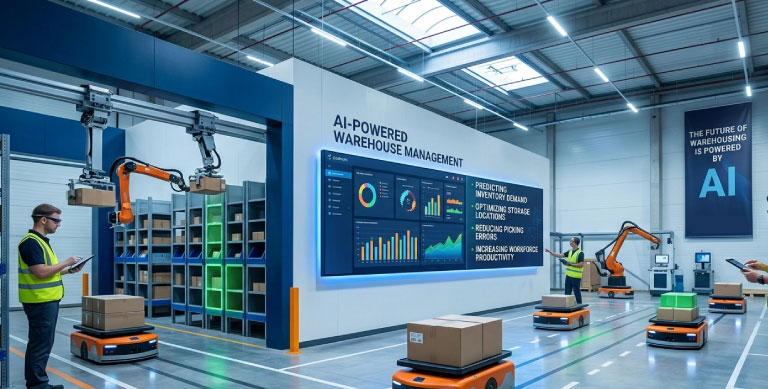
The Future of Warehousing Isn’t Coming It’s Already Here
Warehouses have evolved far beyond being simple storage facilities. In today’s fast-paced supply chain environment, they have become intelligent fulfillment hubs where speed, accuracy, and real-time decision-making determine business success.
With increasing customer expectations, labor shortages, and rising operational costs, traditional warehouse management methods are no longer enough. Artificial Intelligence (AI) is revolutionizing warehouse operations by enabling organizations to automate processes, predict demand, optimize inventory, and make smarter decisions in real time.
Businesses that embrace AI today are building warehouses that are faster, more efficient, and prepared for tomorrow’s challenges.
What is AI in Warehousing?
Artificial Intelligence in warehousing refers to the use of machine learning, predictive analytics, computer vision, and automation technologies to improve warehouse operations with minimal human intervention.
Rather than reacting to operational issues after they occur, AI enables warehouses to anticipate problems, optimize workflows, and continuously improve performance using real-time data.
From receiving goods to order fulfillment and shipping, AI enhances every stage of warehouse operation.
How AI is Revolutionizing Warehouse Operations
- Intelligent Demand Forecasting
One of the biggest warehouse challenges is maintaining the right inventory levels.
AI analyzes historical sales, seasonal demand, customer buying patterns, promotions, and market trends to accurately forecast future demand. This allows businesses to:
- Reduce stockouts
- Prevent overstocking
- Improve inventory planning
- Lower carrying costs
The result is better inventory availability while minimizing excess capital tied up in stock.
- Smart Inventory Optimization
Traditional warehouses often rely on static storage locations.
AI continuously analyzes inventory movement and automatically recommends the most efficient storage locations based on:
- Product demand
- Order frequency
- Product size
- Picking patterns
- Warehouse congestion
Fast-moving products are positioned closer to dispatch zones, significantly reducing travel time and improving picking efficiency.
- Faster and More Accurate Order Picking
Order picking can account for nearly half of warehouse operating costs.
AI improves picking efficiency by:
- Optimizing picking routes
- Assigning tasks intelligently
- Reducing travel distance
- Supporting voice-directed and mobile picking
- Integrating with autonomous mobile robots (AMRs)
This leads to faster order processing while significantly reducing picking errors.
- Real-Time Warehouse Visibility
Modern warehouses generate enormous volumes of operational data every second.
AI converts this data into actionable insights by providing:
- Live inventory visibility
- Warehouse performance dashboards
- Equipment utilization
- Workforce productivity
- Order tracking
- Bottleneck identification
Managers gain complete visibility across warehouse operations, enabling proactive decision-making instead of reactive firefighting.
- Predictive Maintenance
Unexpected equipment failures can disrupt warehouse operations and delay shipments.
AI continuously monitors the health of warehouse assets, including:
- Conveyors
- Forklifts
- Automated storage systems
- Robotics
- Material handling equipment
By detecting early warning signs, AI schedules maintenance before failures occurs, reducing downtime and extending equipment life.
- Workforce Productivity Optimization
AI doesn’t replace warehouse workers, it empowers them.
By analyzing workload, employee skills, shift schedules, and operational priorities, AI intelligently allocates tasks to maximize productivity.
Benefits include:
- Reduced idle time
- Balanced workloads
- Higher employee efficiency
- Improved operational throughput
Workers spend less time searching for products and more time completing value-added activities.
- AI-Driven Warehouse Analytics
Traditional reports explain what happened yesterday.
AI analytics explain:
- Why it happened
- What is happening now
- What is likely to happen next
- What actions should be taken
Predictive dashboards help warehouse managers make informed decisions based on real-time intelligence rather than assumptions.
Business Benefits of AI-Powered Warehousing
Organizations implementing AI-enabled warehouse management experience measurable improvements across operations.
Key benefits include:
- Higher inventory accuracy
- Faster order fulfillment
- Reduced warehouse operating costs
- Increased workforce productivity
- Improved customer satisfaction
- Better space utilization
- Lower inventory carrying costs
- Real-time operational visibility
- Data-driven decision making
- Scalable warehouse operations
These improvements translate into stronger profitability and a more resilient supply chain.
AI + Warehouse Management Systems = Smarter Operations
AI delivers its greatest value when integrated with a robust Warehouse Management System (WMS).
An AI-enabled WMS combines automation, analytics, and operational intelligence to manage:
- Inventory management
- Receiving and put-away
- Order picking
- Packing and shipping
- Returns management
- Barcode and RFID tracking
- Mobile warehouse operations
- Labor management
- Performance analytics
This creates a connected warehouse where every process is optimized using real-time intelligence.
How SCMProFit Powers Intelligent Warehousing
At SCMProFit, we believe warehouses should do more than store inventory—they should think, predict, and optimize.
Our AI-enabled Warehouse Management System helps businesses transform warehouse operations through:
- AI-driven inventory optimization
- Intelligent warehouse automation
- Real-time inventory visibility
- Smart task allocation
- Barcode and RFID integration
- Analytics and performance dashboards
- Seamless ERP integration
- Multi-warehouse management
- B2B and eCommerce fulfillment
- Scalable cloud-based architecture
Whether you’re managing a single warehouse or a global distribution network, SCMProFit enables greater efficiency, accuracy, and operational control.
The Road Ahead
Artificial Intelligence is no longer a futuristic concept—it is becoming a competitive necessity.
Organizations that invest in AI-powered warehousing today are positioning themselves to respond faster to market changes, reduce operational costs, improve customer satisfaction, and build more resilient supply chains.
As technology continues to evolve, AI will play an even greater role in autonomous warehouses, predictive logistics, robotics, and end-to-end supply chain optimization.
The future belongs to businesses that embrace intelligent warehousing today.
Ready to Build a Smarter Warehouse?
Discover how SCMProFit AI-powered Warehouse Management Solution can help you automate operations, improve inventory accuracy, optimize warehouse performance, and deliver exceptional customer experiences.
The Next Generation of Smart Warehousing Starts Here.
