
Subtotal $0.00

How Hormuz Tensions Are Redrawing the UAE’s Trade Map
A Chokepoint Under Pressure
For decades, the Strait of Hormuz has been the artery through which roughly a fifth of the world’s oil and a similar share of its LNG has flowed. That artery has narrowed dramatically in 2026. Since renewed hostilities between the US and Iran erupted earlier this year, Iran has repeatedly restricted, rerouted, and at times effectively closed transit through the strait, with tankers reportedly charged an average of $1.5 million to $2 million per crossing as part of a toll regime Tehran has moved from proposal into active implementation.
The idea of taxing passage through Hormuz hasn’t been Iran’s alone. Washington itself floated a 20% levy on all cargo transiting the strait, framing it as reimbursement for the US Navy’s role in guaranteeing safe passage a move the International Maritime Organization publicly opposed, stating there is no legal basis for mandatory transit fees through straits used for international navigation. Whether or not either toll regime survives in its current form, the practical effect on shippers has already landed: traffic through the strait has fallen dramatically, with roughly 100 to 130 vessels a day making the crossing before hostilities began, compared to a fraction of that more recently.
For a trade and re-export economy built around Jebel Ali, this is not background noise. It is the single biggest supply chain disruption the UAE has faced in a generation, and it is forcing a rethink of where the country’s economic center of gravity should sit.
The Cost Is Already Being Felt in Dubai
Jebel Ali sits inside the Arabian Gulf, which means every container that moves through it is exposed to the same chokepoint risk as an oil tanker. At the height of the disruption this year, activity at the port dropped by as much as 95%, forcing importers and retailers to divert goods through eastern UAE terminals and truck them overland instead. For businesses that depend on predictable restocking cycles the shops, distributors, and free-zone traders that make up so much of Dubai’s commercial identity that kind of volatility translates directly into higher landed costs, longer lead times, and thinner margins. A toll on every barrel or container that transits Hormuz, layered on top of war-risk insurance premiums that have already spiked, is effectively a tax on doing business through Dubai’s traditional gateway.
Enter Fujairah: The UAE’s Insurance Policy
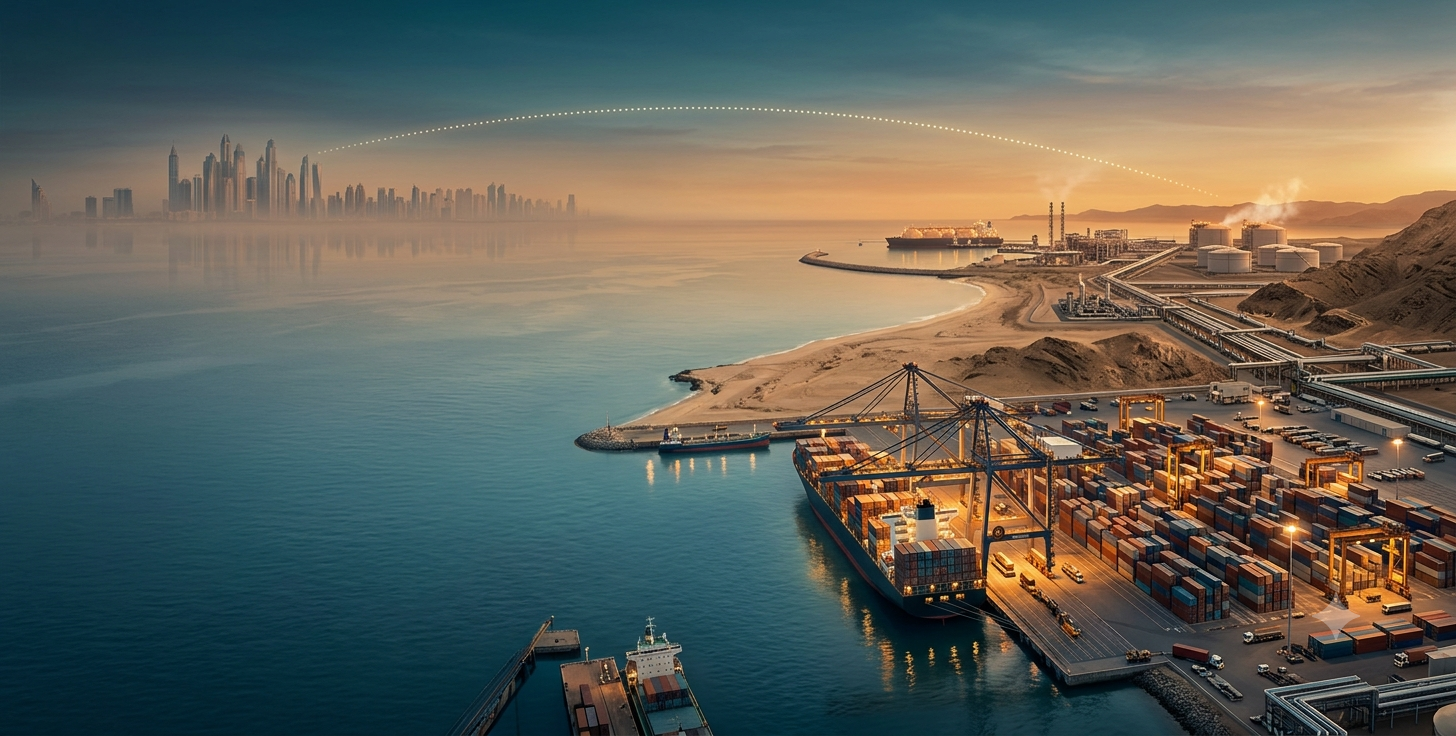
The response has been swift, and it has a name: Fujairah. Unlike the UAE’s other six emirates, Fujairah sits on the Gulf of Oman side of the peninsula, outside the strait entirely. This geographic advantage allows vessels operating from Fujairah to reach international shipping routes without ever passing through Hormuz and it’s precisely why the emirate has gone from a quiet bunkering hub to the centerpiece of the UAE’s trade resilience strategy.
DP World, Dubai’s own ports and logistics giant, is now leading the charge. The company is developing a new multipurpose port and a separate container terminal in Fujairah, designed to let cargo enter the UAE via the Gulf of Oman before moving overland to Dubai, Abu Dhabi, and neighboring Gulf states. A senior DP World official described the move to the Financial Times as a defensive hedge in case the regional situation deteriorates further language that signals this is meant to be a permanent strategic fallback, not a temporary crisis measure.
Importantly, this is being framed as diversification rather than relocation. Jebel Ali is expected to remain the country’s principal container and logistics hub thanks to its scale, free-zone ecosystem, and global shipping connections, with the Fujairah facility acting as a strategic backup that can absorb cargo during emergencies. Sharjah’s Gulftainer is moving in parallel: the company is advancing a $2 billion investment to expand capacity at nearby Khor Fakkan, reinforcing the entire east coast not just Fujairah as a trade gateway of national importance.
The Pipelines Behind the Port
Fujairah’s new prominence isn’t only about container boxes it’s built on two decades of energy infrastructure that is now being doubled down on.
The existing backbone is the Abu Dhabi Crude Oil Pipeline (also called the Habshan–Fujairah pipeline), a 380-kilometre line running from the Habshan oil and gas fields in southwest Abu Dhabi to Fujairah, operational since 2012 and carrying up to roughly 1.5–1.8 million barrels a day oil that never has to cross Hormuz at all.
That capacity is now being doubled. Abu Dhabi’s Crown Prince has directed ADNOC to fast-track the new West-East Pipeline, aiming to double export capacity to Fujairah by 2027, and as of mid-2026 the project was already about 50% complete, with an operational target of 2027. Once both pipelines are fully operational, the UAE expects to move roughly 3.6 million barrels a day directly to Fujairah, completely bypassing the strait.
On the gas side, the shift is just as significant. ADNOC has planned a new LNG plant at Fujairah with capacity of up to 9.6 million tonnes a year more than doubling the UAE’s existing LNG export capacity at Das Island with a dedicated pipeline linking Abu Dhabi’s Habshan gas facilities directly to the new Fujairah plant. Combined with the crude pipelines and a reported push toward a broader multi-fuel pipeline network, Fujairah is being positioned not just as a port, but as an integrated energy export hub.
Rail Is Closing the Loop
None of this works without inland connectivity, and that piece is falling into place too. Etihad Rail, which has run freight services since 2023, began passenger services to Fujairah this year knitting the east coast into the same national logistics network that serves Dubai and Abu Dhabi. That overland link is exactly what lets DP World’s Fujairah terminals function as a genuine extension of Jebel Ali rather than an isolated facility: cargo lands on the Gulf of Oman coast, then moves by road or rail into the country’s main commercial centers without ever touching the strait.
A Geographic and Strategic Shift, not a Replacement
It’s worth being precise about what’s happening here. The UAE is not abandoning Dubai or Abu Dhabi as its commercial and financial centers both retain their scale, infrastructure, and global connectivity. What’s changing is where physical trade enters the country. The east coast, once a secondary node known mainly for bunkering and rock quarrying, is becoming the UAE’s primary insurance policy against a chokepoint it does not control.
For supply chain planners, freight forwarders, and retailers operating in or through the UAE, the practical takeaways are clear:
-
- Diversify routing assumptions. Jebel Ali remains central, but contingency planning should now factor in Fujairah and Khor Fakkan as live alternatives, not theoretical ones.
- Expect overland cost components. Cargo landing on the east coast adds a road or rail leg to reach Dubai and Abu Dhabi markets a cost and time factor that wasn’t part of traditional Gulf-side routing.
- Watch the energy side closely. Oil and gas pipeline capacity to Fujairah is a leading indicator of how seriously the UAE is investing in this shift; the 2027 targets for the West-East pipeline and the new LNG plant are worth tracking as milestones.
- Toll and tariff risk is now a planning variable. Whether tolls settle at Iranian, US, or some negotiated rate, the era of treating Hormuz transit as a fixed, cost-free assumption in landed-cost models appears to be over.
The Bigger Picture
What’s unfolding is less a single project than a structural repositioning of the UAE’s trade geography a hedge built in concrete, pipeline steel, and rail track against a chokepoint that has proven far less reliable than a generation of Gulf logistics planning assumed. Fujairah won’t replace Dubai. But it is fast becoming the reason Dubai’s trade model can keep functioning even when the strait it has long depended on doesn’t cooperate.
This is a sensitive and rapidly evolving geopolitical situation figures on tolls, pipeline completion dates, and port capacity are current as of late July 2026 and may shift as negotiations between the US, Iran, and Gulf states continue.
