
Subtotal $0.00

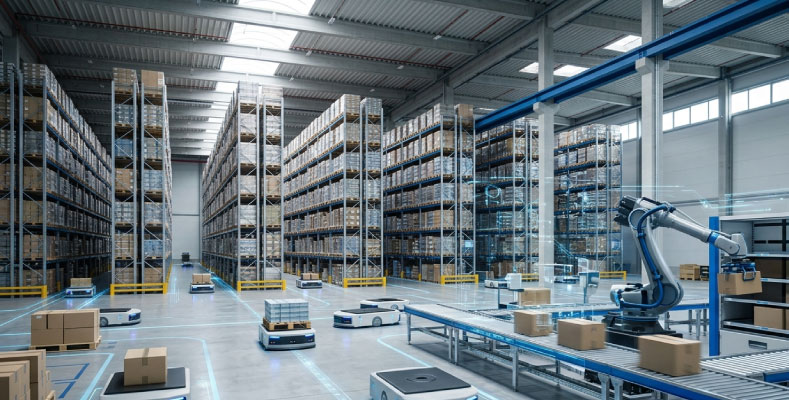
Warehousing has quietly become one of the most dynamic corners of the supply chain. What used to be a static box for storing pallets is now a data-driven, technology-heavy hub that can make or break a company’s ability to serve customers. As we move through 2026, a handful of clear trends are defining how leading operators design, build, and run their facilities. Here’s a look at what’s shaping warehousing this year and what it means for supply chain leaders planning their next move.
- Automation Has Become the Baseline, not a Bonus
For years, automation was treated as a competitive differentiator something only the biggest players could justify. That thinking has flipped. Persistent labor shortages, rising real estate and labor costs, and relentless e-commerce volumes have pushed automation from “nice to have” into “cost of doing business.”
The mix of technologies on the floor has also matured. Automated Guided Vehicles (AGVs) that follow fixed routes are increasingly working alongside Autonomous Mobile Robots (AMRs) that navigate dynamically using sensors and onboard intelligence. Collaborative robots, or cobots, are taking over repetitive tasks like case handling and packing, freeing human workers for higher-value work. Robotic de-palletizing and pallet-building systems, once a novelty, are now solving one of the toughest ergonomic challenges in the warehouse.
Perhaps the biggest shift is financial rather than technical: Robotics-as-a-Service (RaaS) models are removing the massive upfront capital barrier that used to keep automation out of reach for mid-sized operators. Instead of buying a fleet outright, warehouses can subscribe to robotic capacity and scale it up or down as demand shifts turning automation into an operating expense rather than a capital gamble.
- AI Moves from the Back Office to the Warehouse Floor
Artificial intelligence in warehousing used to mean dashboards and after-the-fact reporting. That’s no longer the case. AI is increasingly embedded directly into daily operations guiding slotting decisions, forecasting demand, flagging anomalies, and even answering operational questions in real time through conversational tools layered on top of Warehouse Management Systems (WMS) and ERP data.
This shift matters because it changes the role of the WMS itself. Rather than simply recording transactions, modern systems are expected to interpret data and recommend or automatically execute the next best action. Combined with AI-driven vision systems that identify products, barcodes, and packaging conditions on the fly, the warehouse is starting to behave less like a passive storage facility and more like an adaptive system that senses and responds to changing conditions in real time.
- Orchestration Over Isolated Tools
As warehouses have layered in robotics, WMS platforms, warehouse execution systems (WES), and ERP tools over the years, many ended up with a patchwork of disconnected systems sometimes referred to as “Frankenstacks.” The 2026 trend is consolidation: unifying these tools under software-led orchestration platforms that let robots, human workers, and business systems operate from the same real-time picture.
This isn’t about adding more technology it’s about making the technology already in place talk to each other. The operators pulling ahead aren’t necessarily the ones with the most automation; they’re the ones who’ve integrated it best.
- Inbound Logistics Finally Gets Its Due
Outbound fulfillment has dominated warehouse innovation conversations for years, largely because of e-commerce pressure to ship fast. In 2026, inbound operations are catching up. Real-time dock scheduling, predictive arrival tracking, and digital check-ins are replacing the guesswork that used to define receiving docks, cutting congestion and dwell time.
Native case handling moving goods directly from case to shelf rather than through repeated repackaging steps combined with AI-enabled vision inspection at receiving, is trimming touches and errors before goods ever reach storage. As automation ROI on the outbound side plateaus, inbound is emerging as the next frontier for efficiency gains.
- Buildings Are Being Designed for Automation and Flexibility from Day One
The physical warehouse itself is changing shape. Clear heights of 36 to 40 feet are now common in new industrial construction, driven by the economics of vertical storage as industrial land near population centers becomes scarcer and more expensive. Building taller from the outset rather than retrofitting later is far cheaper and supports high-bay racking, automated storage and retrieval systems (AS/RS), and mezzanine levels.
Flexibility is the other design priority. Modular racking, movable shelving, and reconfigurable zones let a single facility flex between storage, picking, returns processing, and light assembly as SKU profiles and order patterns shift. Facilities are also being designed with digital and connectivity infrastructure built in from the start, rather than bolted on afterward, so that real-time visibility isn’t an upgrade project but a default feature.
- Resilience and Geopolitics Are Reshaping Networks
Ongoing geopolitical uncertainty, tariff volatility, and increasingly unpredictable weather events are keeping supply chain resilience at the top of the agenda. Many companies are responding by diversifying and repositioning their networks including a continued shift toward nearshoring to reduce exposure to any single region or trade route. For warehouse operators, that translates into demand for facilities that can be brought online quickly and flexed geographically, rather than long-term bets on a single fixed footprint.
- Sustainability Moves from Aspiration to Standard Practice
Energy-efficient facility design, on-site renewable power such as solar, and waste-reduction programs are increasingly treated as baseline requirements rather than optional upgrades. This is being driven both by genuine ESG commitments and by the practical reality that energy-efficient buildings cost less to run. Expect recyclable packaging, circular-economy practices, and carbon tracking to become standard line items in warehouse RFPs going forward.
- The Human Element Hasn’t Disappeared
Despite the wave of automation, people remain central to warehouse operations and in a tight labor market, worker experience has become a design consideration. Wearables for health and ergonomics monitoring, AI-assisted training programs, and facility layouts built around human-machine collaboration are becoming more common. The goal isn’t to remove people from the equation, but to make their work safer, less physically taxing, and easier to onboard into.
What This Means for Supply Chain Leaders
Taken together, these trends point to one underlying shift: warehouses are becoming active, adaptive nodes in the supply chain rather than passive storage points. The winners in this environment won’t necessarily be the companies that adopt the most individual technologies, but the ones that integrate automation, AI, data, and people into a single, coherent operating model one flexible enough to absorb the next disruption, whatever form it takes.
For operators still running on legacy systems, the practical starting point is rarely “buy more robots.” It’s auditing where data currently lives, where handoffs between systems break down, and which processes would benefit most from orchestration before adding new hardware on top of an already fragmented stack.
